




Why We Draw Cats
We don’t choose our subjects accidentally. Whether it’s for a business project or purely for pleasure, every choice carries weight. Especially when you draw for yourself—that’s when things get truly symbolic. On a surface level, you might say, “I just decided to draw a cat because I like them; they’re cute, and that’s it.” But I’m convinced that drawing is deeply correlated with our subconscious needs.
If you feel the urge to draw a cat, you have a literal need to manifest your “inner cat” on paper. What exactly your subconscious is trying to tell you is for you to decide, but here is some generally recognized information regarding the symbolism of cats from a psychological and symbolic perspective:
The Symbolism of the Feline
In the world of psychology and archetypes, cats are far more than just pets. First and foremost, they represent autonomy and independence. Unlike many other animals, a cat remains its own master even when living with humans. If you are drawn to sketching a cat, it might be your mind’s way of reclaiming your own boundaries or celebrating your need for freedom.
From a Jungian perspective, cats often symbolize the “Shadow” or the intuitive, mysterious side of our personality. They are creatures of the night, comfortable in the dark and the unknown. Drawing them allows us to tap into our own intuition and the parts of our soul that aren’t always visible in the daylight of our daily routines. Furthermore, cats embody a perfect balance of opposites: they are the ultimate masters of relaxation, yet they can transition into lightning-fast action in a split second. Perhaps by drawing them, you are subconsciously seeking that same balance—knowing when to rest and when to strike.
I also want to share a more personal insight. Back when I was in psychoanalysis, my therapist—who specialized in the symbolic analysis of dreams—always maintained that a cat is a symbol of femininity. She saw it as representing the ‘feminine’ part within all of us, whether we are men or women. You don’t come across this specific interpretation very often, but given her immense experience, I’m inclined to trust her perspective. I’m sharing it with you because it might just resonate with something deep inside you as you draw.
A Few Tips From a Fellow Amateur
I don’t particularly love drawing living creatures. The reason is simple—that’s where it’s immediately obvious that I’m struggling. 🙃 Proportions are everything here, and if you mess them up, the whole thing looks “off.”
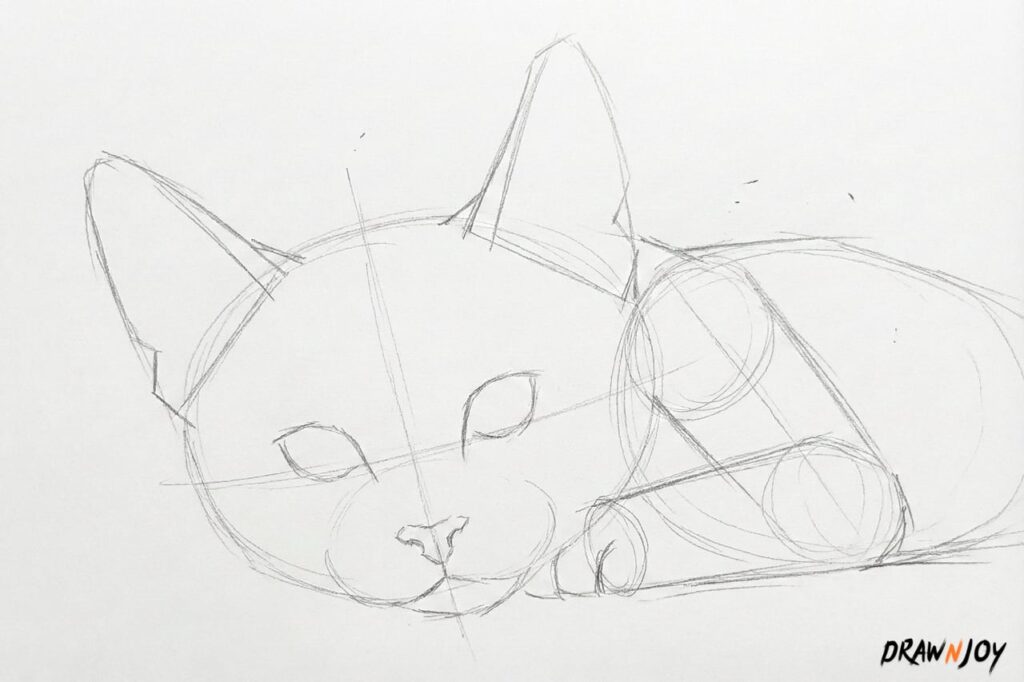
That’s why for this drawing, I suggest making an additional initial sketch using basic geometric shapes as a foundation. This is technically the “right” way to do it. To be fair, I almost never do this myself (mostly because I lack the formal training), but it’s definitely worth trying to maintain the basic proportions.
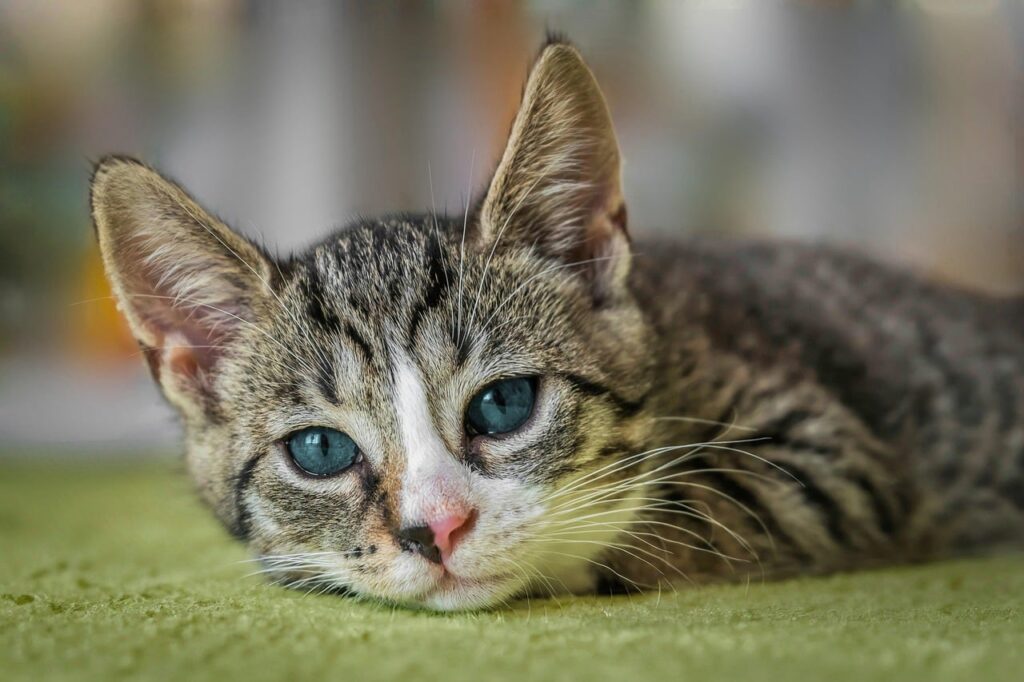
As you’ve noticed, I specifically choose reference photos that don’t have too many complex elements. In this case, you barely have to draw the body or the paws at all. However, the face—while challenging—is the most interesting part to capture.
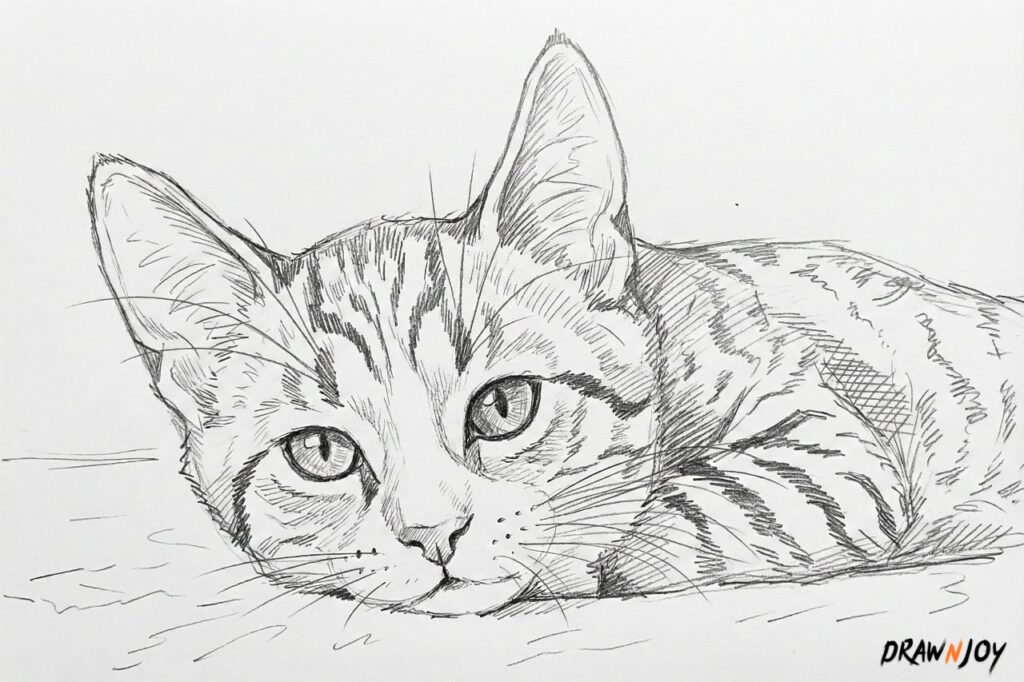
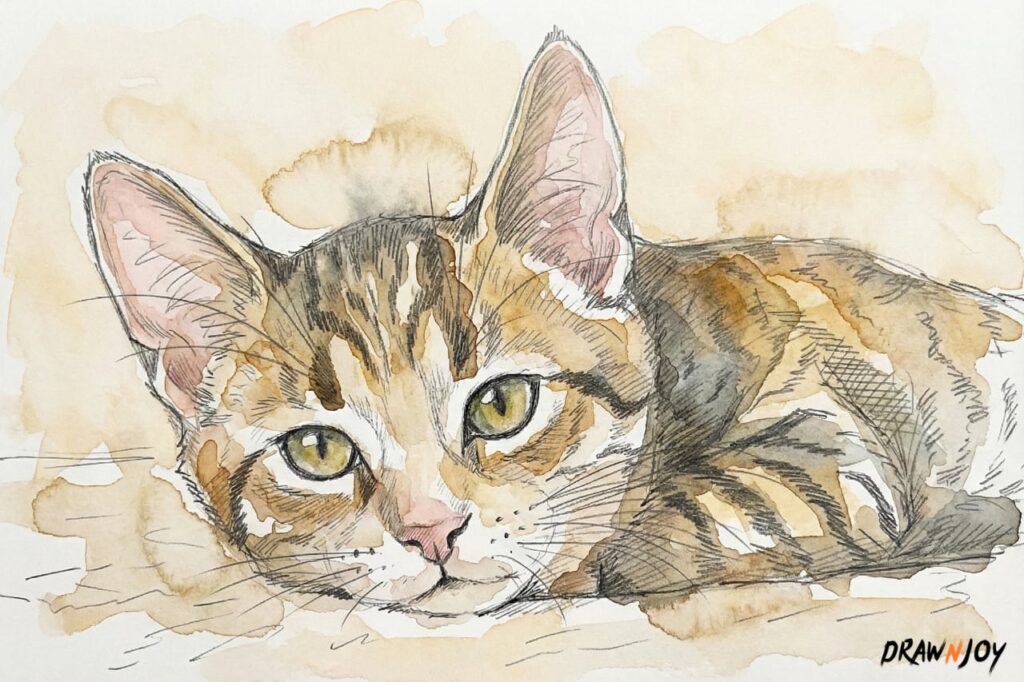
In the example, the sketch is shown in pencil, but the coloring is done in watercolor. I strongly advise against painting watercolor directly over a heavy pencil sketch; you’ll just end up with a muddy mess. Instead of a pencil, try using the thinnest waterproof liner you can find for your outlines. Or, honestly, you can just stop at the sketch stage. I personally love animal drawings even without color.
The most important thing is to just enjoy the process. Here are a few of my own cats, just so you don’t feel too intimidated to start drawing! 😉


Music For Drawing
Reference Photo by Gundula Vogel from Pixabay
Note: The reference photo is real, while the sketch and the colored version were created with the help of AI to serve as inspiration for your own drawing.

Comments